
The early warning signs of every disease occur at a microscopic level. The early warning signs cannot be seen, felt, touched, diagnosed, or discovered. They cannot be noted by their symptoms. The early changes might be able to be detected by sophisticated chemical or biologic analysis, but not by normal diagnostic measures.
By the time you notice that your gums are bleeding (gingivitis), the disease has already been present for some time and it is not in its earliest stage. It is not unusual to hear, “My gums have always bled like this,” but treatment is not sought. Yet if our eyes started to bleed when we washed our faces, we would generally rush to seek medical treatment! Bleeding gums are not normal and healthy. Luckily, at this stage the periodontal disease is fairly easy to treat and is reversible. When the disease has progressed past the bleeding gum stage, you may notice some pain, gum recession, loosening of teeth, and bad breath. If you have ignored your bleeding gums (possibly the earliest sign of gum disease) because you think it is normal to have a little “pink” on your toothbrush, you will likely have additional symptoms and conditions associated with disease progression. At this point the bone and gum support for the teeth may be permanently altered and diminished.
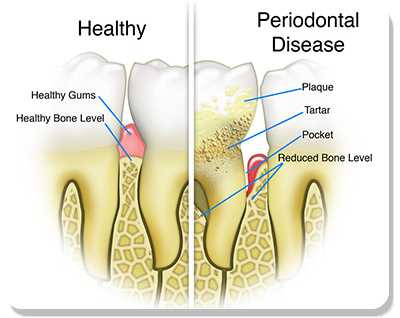
Periodontal disease is an infectious process classified according to how much damage has been done to the structures surrounding the teeth, namely the gingiva (gums) and bone. It is an infection in your mouth. It can happen anytime, around any teeth, affecting some or many of your teeth to varying degrees. There are genetic predisposing factors to periodontal disease, and our immune systems play a role in gum health, but it is usually related to how well you are able to keep your teeth clean through proper oral self-care. The better you clean your teeth to remove all the plaque bacteria, the less likely you will be to develop periodontal disease.
The bacteria that cause this disease first cause the gum tissue to become inflamed and pull away from the teeth. As the problem becomes more serious, the bone that supports the teeth also becomes infected and begins to break down and dissolve. The teeth then become loose. Once the bone disappears, it is extremely hard, if not impossible, for new bone to be rebuilt. The damage is permanent and your teeth, the surrounding bone, and your general health will be compromised.
Periodontal disease is classified into several types. You will be given a separate handout with the appropriate description of the severity of your infection.
The mildest form of this infection will show up in red and swollen gum tissue that bleeds easily. There is seldom any pain involved at this stage. You may notice also that your breath becomes offensive and you feel the need to use mouthwash. Our sense of smell does become immune to the same odors, so we can lose our ability to detect our own offensive, diseased breath. As the disease progresses, the gum tissue becomes more red and swollen, more bleeding can be seen, and the teeth begin to become loose. This tooth mobility is a sign that there is a severe problem. There may still be no pain at this advanced stage. As more and more bone is lost and more teeth become involved in the infection, it becomes harder to treat. At this point, many times, the management of your problem will involve periodontal surgical procedures. If this is the case, you may be referred to a periodontist (gum specialist) for further treatment. Most of the time, periodontal disease starts and continues because of neglect. Brushing and flossing of teeth are not being done effectively on a daily basis. You may have been neglectful in getting your teeth checked and cleaned within the time frame intervals you need. Once we have diagnosed this disease, we will inform you of the problem and suggest treatment. If treatment is not completed, however, the disease will continue to progress. Unfortunately, the disease is quite invisible to most people until severe and possibly irreversible damage has occurred.
Copyright © Aldrich Dental. All rights reserved. | Legal Notes | Privacy Policy